
Third-party sellers now account for 61% of all paid units sold on Amazon (Marketplace Pulse, Q4 2025). Most start with spreadsheets, move to QuickBooks or Xero, and eventually hit a wall: inventory spans multiple locations, entities, or marketplaces, and the accounting system can’t keep up. That’s when Amazon businesses start looking at ERP.
This guide covers how Amazon ecommerce accounting works at scale — settlement accounting, FBA inventory, FIFO costing, SKU profitability, multi-entity reporting — and when NetSuite becomes the right system for it.
Key Takeaways
- Third-party sellers make up 61% of Amazon paid units; 82% use FBA as their primary fulfillment method (Jungle Scout, 2024)
- Amazon pays through 14-day settlement periods aggregating 14+ transaction types — recording revenue from the bank deposit alone produces inaccurate books
- NetSuite maps Amazon events to native transactions (Cash Sales, Expenses, Inventory Transfers), preserving SKU-level profitability and audit trails
- Amazon combined fees typically reach 20-30% of selling price (Amazon Seller Central, 2025) — full visibility requires per-SKU cost allocation
- ERP adoption is triggered by operational complexity (multi-entity, inventory scale, audit readiness), not revenue thresholds alone

What Is NetSuite for Amazon Sellers?
NetSuite for Amazon sellers means implementing Oracle NetSuite as the accounting and ERP system for an Amazon-based ecommerce business. Instead of tracking revenue, inventory, and costs in spreadsheets or small-business accounting software, sellers use NetSuite to handle Amazon settlement accounting, FBA inventory valuation, FIFO costing, SKU-level profitability, and multi-entity financial consolidation. A proper implementation connects Amazon Seller Central to NetSuite through an integration that maps each Amazon transaction type — sales, refunds, fees, reimbursements, inventory adjustments — to the correct native NetSuite transaction. The result is real-time financial visibility at the product, channel, and entity level.
How Amazon Accounting Actually Works
Amazon doesn’t pay sellers per order. It pays through settlement periods — typically every 14 days — that aggregate dozens of transaction types into a single net deposit. That structure is what makes Amazon accounting different from standard retail accounting, and it’s what trips up most sellers who record revenue based on what lands in their bank account.
During each settlement period, Amazon records:
- Product sales and shipping income
- Referral fees, FBA fulfillment fees, storage fees
- Advertising charges and coupon fees
- Customer refunds
- Reimbursements for lost or damaged inventory
- Inventory adjustments and disposal events
- Inbound shipment charges
- Subscription fees and Vine fees
From an accounting perspective, Amazon functions like a clearing account — it collects gross revenue, deducts every fee and refund, then disburses the net balance. If you record that deposit as revenue, your books are wrong from day one. You’re understating gross sales, you can’t see fee expense separately, and your margin calculations are a guess.
Proper Amazon accounting records each transaction type on its transaction date, not the payout date. When done correctly, the total of all transactions in a settlement period nets exactly to the deposit in your bank account.
According to Jungle Scout’s 2025 State of the Amazon Seller report, 57% of Amazon sellers achieve profit margins above 10% (Jungle Scout, 2025). Getting to that kind of margin visibility requires correct settlement accounting — not payout-based bookkeeping that buries gross sales and fees in a single number.
Amazon Settlement Accounting Explained
The most common Amazon accounting mistake is treating the payout as revenue. It overstates revenue in months with low refunds and understates it when large refund batches hit. Neither is accurate, and both make financial statements unreliable for business decisions.
Correct settlement accounting records each Amazon event as its own accounting entry:
| Event | Accounting Entry |
|---|---|
| Product sale | Revenue |
| Referral fee | Expense |
| FBA fulfillment fee | Expense |
| Storage fee | Expense |
| Advertising | Expense |
| Customer refund | Revenue reversal |
| Reimbursement | Other income or expense offset |
| Inventory adjustment | Inventory / COGS adjustment |
| Settlement payout | Transfer to bank |
When all entries are recorded correctly, the transactions in a settlement period should net exactly to the payout deposit. That reconciliation — Amazon settlement reconciliation — is what confirms the accounting is right and provides an auditable transaction trail.
Amazon referral fees range from 5% to 45% depending on category, with most categories at 15%. Add FBA fulfillment fees, storage, and advertising, and the effective Amazon take rate commonly reaches 20-30% of the selling price (Amazon Seller Central, 2025). On $5 million in gross sales, that’s $1-1.5 million in Amazon-related costs. Categorizing those correctly isn’t optional — it’s the difference between knowing your margins and guessing them.
How Amazon Seller Central Connects to NetSuite
A proper Amazon NetSuite integration posts transactions as native NetSuite transactions — not summarized journal entries. Journal entries preserve the cash balance but destroy product-level visibility. You can reconcile the bank, but you can’t see which SKUs are profitable or which fee types are growing.
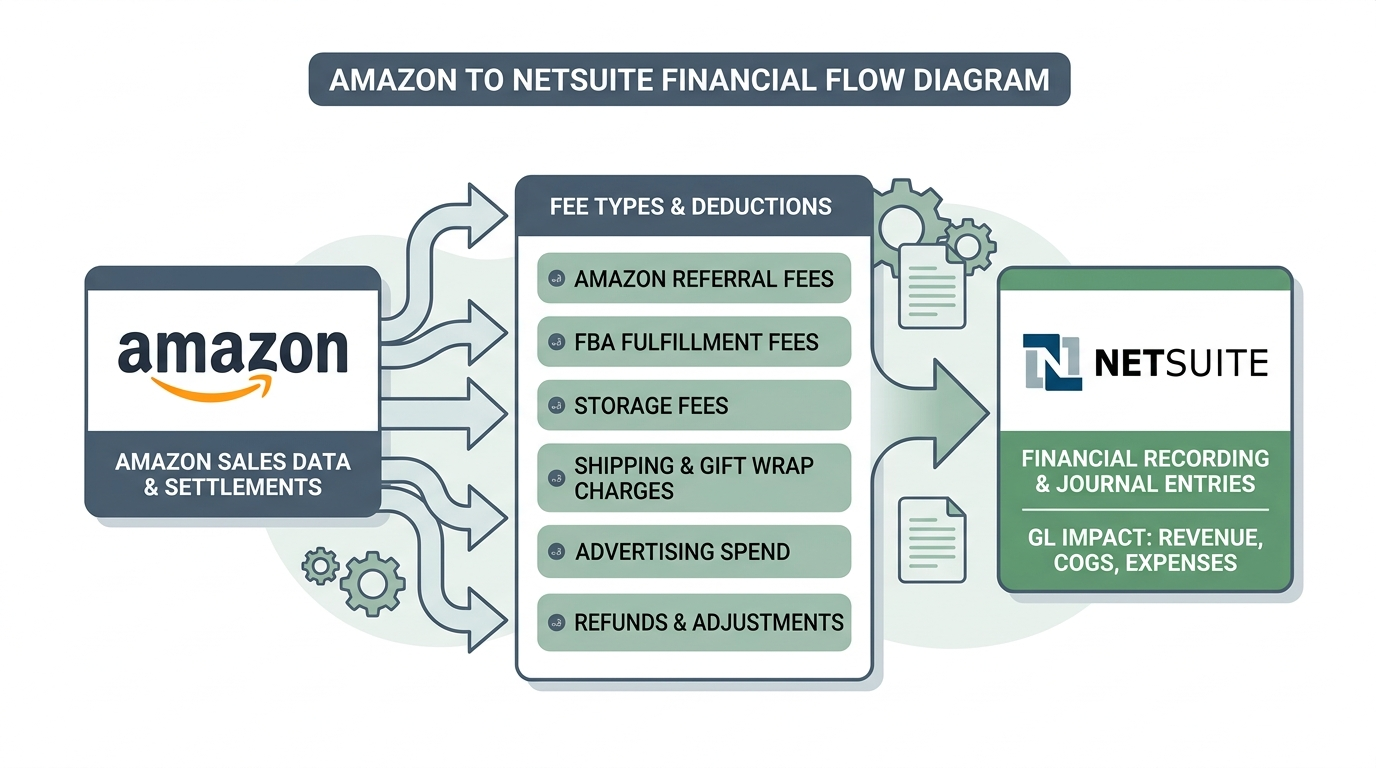
Amazon Event to NetSuite Transaction Mapping
| Amazon Event | NetSuite Transaction |
|---|---|
| Product sale | Cash Sale |
| Customer refund | Cash Refund |
| Referral fee / FBA fee / storage fee | Expense |
| Advertising spend | Expense |
| Inventory reimbursement | Vendor Credit + Deposit |
| FBA inbound shipment | Inventory Transfer |
| Inventory lost/damaged | Inventory Adjustment |
| Settlement payout | Bank Deposit |
Why does this matter? When sales post as Cash Sales tied to inventory items, NetSuite generates SKU-level revenue reports, calculates gross margin per product, and tracks inventory consumption automatically. That data feeds directly into profitability reporting without any manual work at month-end.
Amazon’s third-party seller services generated $156.15 billion in full-year 2024 revenue (Amazon 2024 Annual Report, February 2025). For businesses running at meaningful scale within that ecosystem, the accounting architecture behind the integration determines whether financial reporting is useful or not. Get the mapping right and reporting runs itself. Get it wrong and you’ll spend the last week of every month manually pulling data from Seller Central to reconcile books that were never accurate.
Entriwise is a native NetSuite integration that implements exactly this mapping — native transactions for every Amazon event, individual fee lines per category, settlement-date posting, and automated COGS recognition. See the NetSuite integration platform for details.
Inventory and COGS for Amazon FBA Sellers
Inventory is typically the largest asset on an ecommerce balance sheet. COGS is typically the largest expense on the income statement. If either is wrong, the financial statements are wrong — and decisions made from those statements are wrong too.
FBA sellers hold inventory across multiple locations at once:
- Amazon FBA fulfillment centers (often multiple regions)
- Third-party logistics (3PL) warehouses
- Own warehouse or distribution center
- Inventory in transit (from manufacturer or between locations)
- Returns processing
- Unsellable inventory pools
IHL Group’s 2023 Inventory Distortion Study found that global inventory inaccuracies — out-of-stocks combined with overstocks — cost retailers $1.77 trillion annually, equivalent to 7.2% of global retail sales (IHL Group, 2023). For ecommerce businesses, the accounting dimension is just as significant: incorrect inventory values produce incorrect COGS, which produces incorrect gross margin, which produces incorrect business decisions.
NetSuite tracks inventory across all locations with real-time COGS recognition at point of sale. When a unit sells, the system pulls the correct cost layer and posts COGS automatically. No manual journal entries, no month-end estimates.
FIFO Costing for Amazon FBA Sellers
Both QuickBooks and NetSuite support FIFO. The difference shows up in complex environments — multiple locations, frequent cost changes, high volume — where ERP-level controls become necessary.
What FIFO Means for Amazon Sellers
FIFO (First In, First Out) assigns cost based on when inventory was received. The oldest units are expensed as COGS first; ending inventory is valued at the most recent purchase prices.
Under FIFO:
- Each inventory receipt creates a cost layer at the unit cost on that date.
- When a unit sells, the system pulls cost from the oldest open cost layer.
- Ending inventory reflects the most recent purchase prices.
FIFO is accepted under both GAAP and IFRS and is standard in ecommerce and retail. It’s not complicated in principle. The challenge is keeping the underlying data clean enough for the costing to stay accurate.
When Does FIFO Break Down?
FIFO only stays accurate if:
- Inventory receipts are posted correctly and on time
- Opening inventory balances are right
- Amazon inventory adjustments sync into the accounting system
- Negative inventory doesn’t appear in the system
Incorrect receipts produce incorrect cost layers. Incorrect cost layers produce incorrect COGS — regardless of which costing method you’ve selected. This is why integration accuracy and inventory setup matter so much when implementing NetSuite for Amazon FBA accounting. The costing method is only as good as the data feeding it.
SKU-Level Profitability in NetSuite
Do you actually know which of your SKUs are profitable? Not blended channel margin — true net margin per product, after every Amazon cost is allocated?
Most ecommerce businesses think they do. In practice, most are working from gross margin estimates that don’t fully allocate referral fees, FBA fulfillment fees, storage costs, and return rates at the product level. The result is a P&L that looks healthy overall while a portion of the catalog quietly loses money on every unit shipped.
A proper SKU profitability report in NetSuite includes:
- Revenue per SKU
- Cost of goods sold per SKU
- Amazon referral fee per SKU
- FBA fulfillment fee per SKU
- Storage fee allocation per SKU
- Advertising spend per SKU
- Refund rate and refund cost per SKU
- Net margin per SKU
82% of Amazon sellers use FBA as their primary fulfillment method (Jungle Scout, 2024), which means FBA fees are a line item for the vast majority of sellers. Those fees vary by product dimensions and weight. A large, heavy item with a 15% referral fee plus $9 in FBA fulfillment, $2 in monthly storage, and a $6 advertising cost per unit sold looks very different from a lightweight item at the same selling price — even if gross margin percentages look similar on the surface.
Getting that SKU-level visibility requires a system that allocates costs at the product level, not just the channel level. That kind of analysis is hard to produce in QuickBooks or Xero. It’s standard in ERP systems like NetSuite when the integration is built correctly. See profitability analytics for how Entriwise surfaces this data.
Multi-Entity Ecommerce Accounting
Scaling beyond a single Amazon US account usually means adding legal entities. A UK or EU marketplace requires a local entity. A brand IP holding structure adds another. Wholesale and B2B operations often run under different entities than DTC. And manufacturing may sit in a separate company entirely.
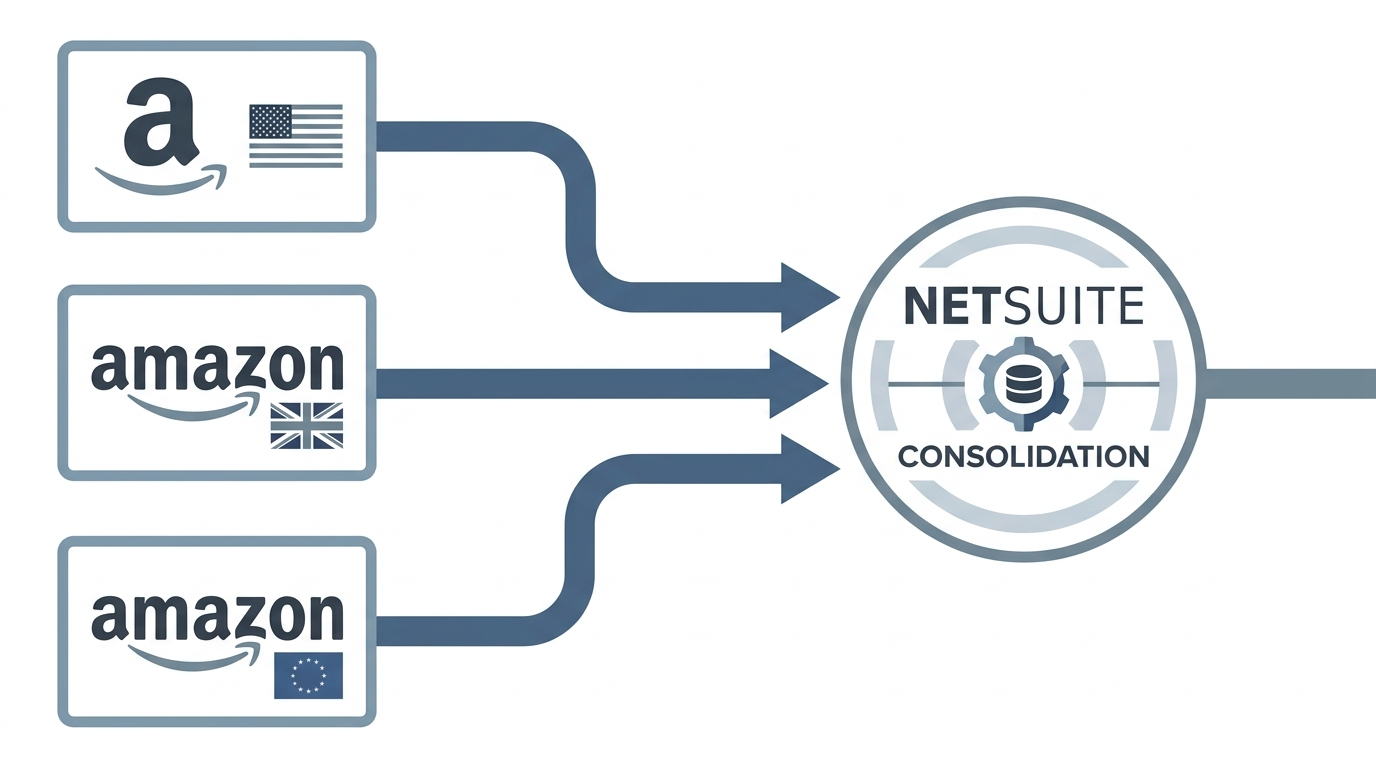
Common multi-entity structures for Amazon businesses include:
- US operating entity + UK or EU subsidiaries
- Parent holding company + operating subsidiaries
- Brand IP entity (separate from the operating business)
- Wholesale or B2B entity
- Manufacturing or sourcing entity
These entities share inventory and costs but need separate books. They may also:
- Transfer inventory between companies at arm’s-length prices
- Operate in multiple currencies with proper foreign exchange accounting
- Produce consolidated financial statements for ownership or investors
- Handle intercompany eliminations so internal transactions don’t inflate revenues
- Comply with VAT (EU and UK) and US sales tax under separate registrations
NetSuite handles all of this in a single system. Subsidiaries run their own books while the platform consolidates financials, eliminates intercompany transactions, and converts currencies automatically. Month-end consolidation that would take days in separate accounting files runs automatically.
78.6% of ERP implementations in 2024 used cloud-based deployment, up from 64.5% the year before, with average implementation timelines dropping from 15.5 months to 9 months (Panorama Consulting Group, 2024). Multi-entity ecommerce accounting is one of the primary drivers pushing businesses toward cloud ERP. The alternative — maintaining separate accounting files and reconciling them manually each month — doesn’t scale.
Multi-Channel Ecommerce Accounting
Most Amazon sellers eventually expand beyond Amazon. Shopify, Walmart, eBay, TikTok Shop, wholesale, international marketplaces — each has its own transaction format, fee structure, and settlement schedule. Managing them in separate systems, or in spreadsheets, produces a financial picture that’s always incomplete.
An ERP system pulls every channel into one accounting system so the business can produce:
- Consolidated P&L across all channels
- Channel-level profitability reporting
- Product profitability across all channels
- Unified inventory valuation
- Consolidated balance sheet
- Cash flow reporting
At that stage, the ERP isn’t just an accounting tool. It’s the financial operating system of the business.
When Amazon Sellers Move to NetSuite
Revenue isn’t the main trigger. Most Amazon businesses don’t move to NetSuite because they hit a specific number. They move because operational complexity outgrows what QuickBooks or Xero can handle.
Common triggers include:
- Multiple legal entities requiring consolidated financial reporting
- International expansion with multi-currency requirements
- Large inventory balances across multiple warehouses or 3PLs
- SKU-level profitability reporting that’s impossible in the current system
- Preparing for audit, investor due diligence, or acquisition
- Month-end close taking longer than two weeks
- Inventory reconciliation problems that can’t be resolved
- Need for ERP-level workflows, approval controls, and permissions
A business with $3 million in revenue but three entities and UK operations may need NetSuite before a $15 million single-entity domestic business does. It comes down to what the accounting system has to track, not how much revenue flows through it.
Conclusion
Amazon accounting is complex because Amazon isn’t just a sales channel. It’s a settlement system, a fulfillment network, a fee processor, and an advertising platform combined. The accounting system has to handle all of it.
As Amazon businesses grow, accounting shifts from bookkeeping to systems architecture — integrations, inventory controls, settlement reconciliation, and multi-entity financial reporting all have to work together for the numbers to mean anything.
NetSuite is the ERP most mid-market Amazon and ecommerce companies land on at scale because it handles:
- Amazon settlement accounting with full transaction detail
- Multi-channel sales across Amazon, Shopify, Walmart, and others
- Multi-entity structures with automatic intercompany eliminations
- Multi-location FBA inventory with FIFO costing
- SKU-level profitability reporting across all cost types
- Consolidated financial statements across subsidiaries
- Audit-ready financials and ERP-level workflow controls
The ERP itself is only part of the answer. How Amazon integrates into it — and how transactions are structured inside the accounting system — determines whether the financial data is actually useful.
Frequently Asked Questions
What is NetSuite for Amazon sellers?
NetSuite for Amazon sellers is implementing Oracle NetSuite as the accounting and ERP system for an Amazon-based ecommerce business. It connects Amazon Seller Central to NetSuite through an integration that maps each Amazon transaction type — sales, refunds, fees, reimbursements, inventory adjustments — to the correct native NetSuite transaction. The result is accurate financial reporting at the SKU, channel, and entity level, with full audit trails and automated COGS recognition.
How does Amazon settlement accounting work in NetSuite?
Amazon settlement accounting in NetSuite maps each Amazon transaction to its correct accounting entry: sales post as Cash Sales, fees post as Expenses, refunds post as Cash Refunds, and the settlement payout posts as a Bank Deposit. The sum of all entries for a settlement period should net exactly to the bank deposit. That reconciliation confirms the accounting is accurate and provides the transaction-level audit trail needed for financial statements.
What is Amazon FBA accounting?
Amazon FBA accounting is the process of recording FBA-specific transactions — fulfillment fees, storage fees, inventory movements between fulfillment centers, reimbursements for lost or damaged goods, and inbound shipment costs — in an accounting system. Because FBA inventory moves between fulfillment centers continuously, FBA accounting requires tracking inventory across multiple locations with accurate cost layers for FIFO costing. NetSuite automates this with native multi-location inventory tracking and COGS recognition at point of sale.
Can NetSuite track SKU profitability for Amazon sellers?
Yes. When Amazon sales post as Cash Sales tied to inventory items in NetSuite, the system generates SKU-level reports showing revenue, COGS, gross margin, fee allocations, and advertising spend per product. This gives sellers true net margin per SKU — not a blended channel margin — making it possible to identify which products are actually profitable after all Amazon costs are accounted for.
When should an Amazon seller move from QuickBooks to NetSuite?
The decision usually comes down to complexity, not revenue. Common triggers include operating multiple legal entities, expanding internationally, holding large inventory balances across multiple locations or 3PLs, needing SKU-level profitability reporting, or preparing for audit or acquisition. A single-entity domestic Amazon business may stay on QuickBooks for years; a multi-entity business with UK and EU operations often needs NetSuite well before it hits significant scale.
What does an Amazon NetSuite integration do?
An Amazon NetSuite integration pulls transaction data from Amazon Seller Central and posts it into NetSuite as native transactions. A well-built integration maps product sales to Cash Sales, fees to Expense records, refunds to Cash Refunds, inventory movements to Inventory Transfers, and settlement payouts to Bank Deposits. It also handles inventory item matching so COGS posts automatically at the point of sale. The integration replaces manual data entry, eliminates settlement reconciliation work, and keeps inventory valuation current in NetSuite.