
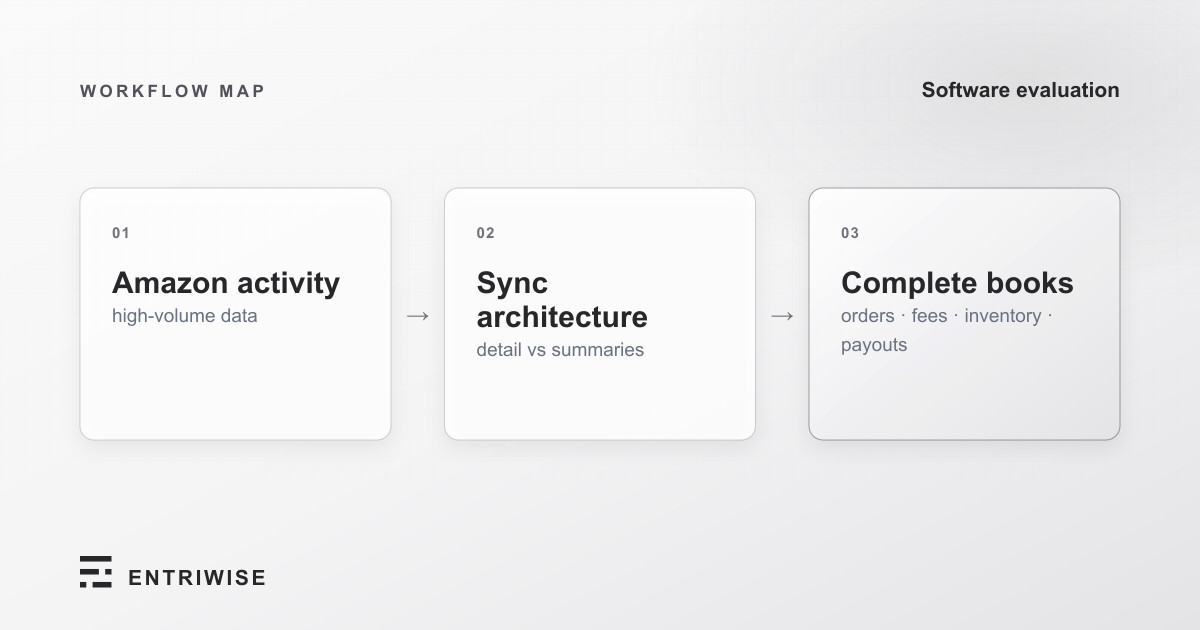
For high-volume Amazon sellers, NetSuite is the best accounting platform once you pass roughly $10M in revenue, run several entities or sell through wholesale and other channels alongside Amazon. QuickBooks Online Advanced is the best choice for sellers who sell mostly through FBA, don’t need the ledger to track stock by location and want to stay lean, and QuickBooks Desktop Enterprise suits single-entity sellers with heavy inventory who need stock tracked by location: FBA, inbound shipments, removals and 3PLs. Xero is the cheapest option but the weakest fit at high volume for US sellers. Whichever ledger you pick, the Amazon integration that feeds it matters almost as much as the ledger itself.
Why high volume breaks basic bookkeeping
Most lists of the best accounting software for Amazon sellers are written for a seller doing a few hundred orders a month, who can get by with almost any ledger and a connector. At thousands of orders a day, across several marketplaces and channels, the cracks show fast:
-
Transaction volume. Every settlement can carry tens of thousands of lines: orders, fees, refunds, reimbursements, ads and reserves. Syncing them one by one slows your books to a crawl, and even a daily summary can carry hundreds of inventory lines in one document. The ledger has to handle large documents as well as many of them.
-
Inventory across many locations. Stock sits in FBA warehouses, 3PLs, your own warehouse and inbound shipments. COGS, landed cost and shrinkage must be right by SKU and location.
-
Multiple marketplaces and entities. Amazon US, Canada, UK and EU often mean several currencies, tax regimes and sometimes separate legal entities to consolidate.
-
Month-end close. Lenders, investors and acquirers expect accrual-basis financials closed in days, not weeks.
-
Controls and audit trail. More people touch the books, so you need user roles, approvals and a clean audit trail. No accounting platform solves these problems by itself. NetSuite, QuickBooks and Xero don’t read Amazon settlements, map Amazon’s dozens of fee types or know which SKUs left which FBA warehouse. That’s why Amazon seller accounting software is really two pieces: a ledger and an integration that turns Amazon activity into accounting-ready transactions, and the quality of that integration decides whether the ledger can keep up.
What high-volume sellers should look for
We judged each platform on the criteria that matter when you choose Amazon FBA accounting software at high volume:
-
Scalability. Can it handle tens of thousands of transactions a year, documents with hundreds of lines and many users working at once?
-
Inventory depth. Multi-location stock, landed cost, units of measure, assemblies and kitting, ideally in the core system rather than a bolt-on.
-
Multi-entity and multi-currency. Can it consolidate several companies and marketplaces in different currencies?
-
Integrations at scale. Can an Amazon integration post native, inventory-aware transactions into it daily, rather than one summary journal entry per settlement?
-
Controls and reporting. User roles, approval workflows, audit trail and real-time dashboards.
-
Total cost of ownership. Licenses, add-ons, implementation and the staff needed to run it.
At a glance: NetSuite vs. QuickBooks Desktop vs. QuickBooks Online vs. Xero
| NetSuite | QuickBooks Desktop Enterprise | QuickBooks Online Advanced | Xero Established | |
|---|---|---|---|---|
| Best for | $10M+ OR multi-entity | Inventory-heavy sellers who need stock tracked by location | FBA-focused sellers who don’t need stock by location | Small sellers |
| Price, 2 users | ~$15,100–$16,800/yr | Platinum $3,728/yr; Diamond $6,420/yr | $4,080/yr (up to 25 users) | $1,164/yr (unlimited users) |
| Price, 5 users | ~$19,700–$23,900/yr | Platinum $6,040/yr; Diamond $8,976/yr | $4,080/yr | $1,164/yr |
| Deployment | Cloud | Locally installed or cloud hosted (extra fees) | Cloud | Cloud |
| Users | Paid per user | Up to 40 depending on edition | Up to 25 | Unlimited |
| Native inventory | Multi-location, landed cost, demand planning | Sites, bins, serial and lot tracking (Platinum and Diamond) | FIFO; one stock count per item, not by location | Up to 4,000 tracked items, average cost only; FIFO and multiple locations need Inventory Plus (US only) |
| Landed cost | Native | Platinum and Diamond | Not supported | Not supported |
| Units of measure | Native | Platinum and Diamond (Advanced Inventory) | Not supported | Not supported |
| Multi-entity | Native consolidation with OneWorld | Separate company files | Separate subscription per company | Separate subscription per company |
| Amazon integration choice | Narrower: integration platforms, custom builds and a few dedicated connectors | Narrow; many tools rely on file imports | Widest | Wide |
| Implementation | Months, usually with a partner | Days to weeks | Weeks | Weeks |
Prices are annual list prices as of November 2026, before promotions; plans billed monthly are shown at 12 times the monthly price. NetSuite doesn’t publish prices, so its figures are third-party estimates of the base license plus full user licenses. QuickBooks Desktop Enterprise prices are for Platinum and Diamond, the editions that include Advanced Inventory; Gold doesn’t.
1. NetSuite: best overall for high-volume Amazon sellers
Oracle NetSuite is a full cloud ERP. It runs the general ledger, inventory, purchasing, order management, demand planning and multi-entity consolidation in one system. That makes it the strongest system of record for a high-volume seller.
Pricing: Oracle doesn’t publish prices. Third-party estimates put the base license at about $12,000 per year and up, plus $1,548 to $2,388 per full user per year. Modules such as advanced inventory and OneWorld cost extra, and implementation typically runs for months.
Pros
-
Native multi-location inventory with landed cost, multiple units of measure, assemblies, kitting and lot tracking
-
OneWorld consolidates multiple entities, currencies and tax regimes
-
Handles very large transaction volumes and many concurrent users
-
Roles, approvals and audit trails that satisfy lenders, auditors and acquirers Cons
-
The most expensive option by far, with a long implementation
-
Needs a finance team or outsourced controller to run well
-
Doesn’t understand Amazon on its own: without an integration, Amazon revenue often lands as manual journal entries
Which Amazon integration tool complements NetSuite the best?
You bought NetSuite for visibility, and a single blended “Amazon revenue” entry wastes it. Entriwise’s Amazon NetSuite integration posts Amazon activity into NetSuite’s own records, as cash sales or invoices, so the ERP does the work you’re paying for:
-
Daily summaries, not one record per order. Each day’s Amazon activity posts as compact summary transactions, 10× to 1000× fewer records than one per order, so imports stay fast and NetSuite transaction volume stays low. Fees and refunds post at least daily, so profit isn’t overstated while a statement is still open. This is how Entriwise handles 1,000,000+ orders a month for its largest sellers.
-
OneWorld subsidiaries and segments. Routes each marketplace to the right entity, Amazon US to the US subsidiary and Amazon UK to the UK subsidiary, with currency handled correctly. Departments, classes and custom segments let you compare FBA against wholesale or DTC.
-
Returns done right. Posts the refund, restocks sellable units to the correct location and reverses COGS using the item’s own costing method in NetSuite. Sellable and damaged returns are handled as separate financial and inventory events, so units are never returned twice.
-
Fees allocated to items. Referral commissions, FBA fees and Amazon PPC ad spend are allocated down to child SKUs, so profitability reflects each product’s real costs. Advanced inventory mapping
Amazon catalogs are rarely clean, and this is where generic integrations usually need custom scripts. Entriwise handles the common cases natively:
| Feature | What it does | Example |
|---|---|---|
| Many-to-one SKU mapping | Routes several Amazon listings, including mismatched SKUs, to one NetSuite item | FBA and seller-fulfilled listings of the same product deduct from one item |
| Multipack multipliers | Converts pack sales into base-unit quantities | A 10-pack sold on Amazon deducts exactly 10 units of the base item |
| Bundles and kits | Expands a bundle SKU into its component items and deducts inventory at the component level | A “starter kit” sale relieves stock and COGS for each item inside it |
| Price allocation rules | Controls how bundle revenue is split across components, preserving the exact amount and tax totals | A $50 bundle’s revenue is split across its components by the rule you set, with rounding absorbed by the final line |
| Assembly items | Maps Amazon SKUs to NetSuite assembly items | A finished good built from raw materials sells through as one assembly |
| Locations | Separates FBA, inbound, removal and seller-fulfilled stock by NetSuite location | “Amazon FBA US” and “Amazon FBA UK” tracked as distinct locations |
| Lot and bin numbers | Assigns lot and bin numbers automatically when posting cash sales or invoices | Lot-tracked supplements keep traceability without manual entry |
| Inventory movements | Posts lost, found, damaged, inbound, removal, vendor-return and AWD movements | An FBA “lost” adjustment writes off units without a manual entry |
Built-in controls protect the numbers. Every closed Amazon statement is reconciled automatically: Entriwise compares the posted total with the statement total before it marks the payout reconciled. Mapping totals are checked whenever a SKU, bundle, fee or tax line is split, and Entriwise reads each created record back from NetSuite to verify the amount, removing and reporting any record that does not match instead of leaving it in your books.
Because all of this detail lives in NetSuite’s native inventory and A/R records, not in an external subledger, your ERP stays the single source of truth.
Other options: Oracle’s own NetSuite Connector posts one cash sale per FBA order and handles listing sync, and it can run alongside Entriwise, with Oracle handling listings. Integration platforms such as Celigo can do similar work with custom mapping and ongoing maintenance. A2X has offered NetSuite in early access since 2023, posting one summarized journal entry per payout.
Verdict: NetSuite with Entriwise is the strongest pairing for sellers above roughly $10M in revenue, and for anyone with multiple entities, several warehouses, complex bundles or a wholesale channel alongside Amazon.
2. QuickBooks Desktop Enterprise: best for inventory-heavy sellers
QuickBooks Desktop Enterprise has genuinely strong inventory: multiple sites, bins, serial and lot tracking. That’s why many established Amazon sellers still run on it. Intuit is steering new customers to the cloud, though. It stopped selling new Pro Plus, Premier Plus and Mac Plus subscriptions on September 30, 2024, and Enterprise is now the only Desktop edition new customers can buy. Advanced Inventory, which adds multiple sites, bins, serial and lot tracking, FIFO costing and multiple units of measure, comes with Platinum and Diamond but not Gold, and so does landed cost, so Platinum is the entry point for Amazon sellers. Platinum costs $2,717 per year for one user, $3,728 for two and $6,040 for five, plus a payroll fee of up to $36 per employee per year. Diamond is sold monthly only, from $5,364 per year for one user, $6,420 for two and $8,976 for five.
Pros
-
Advanced inventory features built in
-
Fast and familiar for long-time users
-
Supports up to 40 users depending on edition Cons
-
Desktop architecture: remote teams need paid hosting
-
Few modern Amazon integrations; many tools support it only through manual IIF file imports, without SKU or inventory data
-
No real multi-entity consolidation and an uncertain long-term roadmap
Which Amazon integration tool complements QuickBooks Desktop Enterprise the best?
Desktop Enterprise has the thinnest integration market of the four. Some popular settlement tools support it only through IIF file exports imported by hand, without SKU or inventory data, and Webgility syncs orders in detail. Entriwise’s Amazon QuickBooks Desktop Enterprise integration instead posts directly into your company file and is built around Enterprise’s Advanced Inventory:
-
Accrual accounting without journal entries. Sales are recorded when orders ship, and sales, refunds and fees import as fully itemized QuickBooks documents. Imports can run hourly, daily or on demand, with daily summaries for high volume.
-
Itemized fee mapping. Amazon’s fee structure maps to specific QuickBooks items, with a full audit trail back to each settlement report.
-
Class and Customer:Job reporting. Separate FBA from merchant-fulfilled sales, track each marketplace and manage multiple brands in your existing reports. Advanced inventory mapping
| Feature | What it does | Example |
|---|---|---|
| Inventory sites | Maps Amazon’s logistics to Advanced Inventory sites | Separate sites for FBA, inbound shipments, removal orders and merchant-fulfilled stock |
| Inventory assemblies | Maps multipacks and bundles to Enterprise inventory assemblies | A bundle sells through as one assembly built from its components |
| Many-to-one SKU mapping | Routes several Amazon listings to one inventory item | Multiple listings of one product share a single stock count |
| Bundle price distribution | Distributes bundle revenue across the items inside it | Revenue and margin reported for each component |
| Actual COGS | Uses Enterprise’s own costs, including landed costs from bills and assembly build costs, under Average or FIFO valuation | Each sale costed by the valuation method you already use |
| Extra COGS and fee allocation | Adds prep, labeling or freight costs per unit or by percentage, and allocates Amazon fees and ad spend to each SKU | True per-product profitability, not just gross margin |
Verdict: For sellers on Desktop Enterprise, Entriwise is the best pairing because it uses the inventory features you chose Enterprise for. Every Amazon seller holds stock in several places: FBA, inbound shipments, removals and often a 3PL or prep center. Sellers who don’t need the ledger to show where units sit can track that as one count per item in QBO Advanced. Sellers who need the ledger to show stock by location, or who rely on assemblies and lot tracking, are a better fit for Enterprise, as long as they accept a desktop application with hosting for remote teams. Current users can switch to NetSuite later without changing integrations.
3. QuickBooks Online Advanced: best for scaling sellers who want to stay lean
QuickBooks Online Advanced ($4,080/year) is the top QBO tier and the natural step before an ERP. It supports up to 25 users, custom roles, batch transactions, workflow automation and deeper reporting, and almost every ecommerce accountant knows it.
Pros
-
Much lower cost and faster setup than an ERP
-
Built-in FIFO inventory engine that calculates COGS from real transactions
-
Class and location tracking for profit by marketplace or channel
-
Easy for outside accountants to work in Cons
-
Pushing every Amazon order in as its own document slows reports and clutters the file
-
No native multi-entity consolidation
-
No inventory by location: FBA, inbound, removal and 3PL stock share one count per item, so the ledger can’t show where units sit
-
No landed cost and no units of measure: freight, duties and other import costs must be added to item costs by hand, and each pack size (single, 12-pack, case) has to be a separate product with its own stock count
Which Amazon integration tool complements QuickBooks Online the best?
Most QBO connectors take one of two routes. Settlement-summary tools (A2X, Link My Books) post one journal entry per payout, usually every 14 days, which bypasses QBO’s inventory engine. Order-level tools such as Webgility post every order, which can bloat the file at high volume. Entriwise’s Amazon QuickBooks Online integration sits between them:
-
Daily summaries as real QuickBooks documents. Each day’s Amazon activity posts as itemized documents, not journal entries, so QBO stays fast and your P&L is never more than a day behind.
-
Inventory and FIFO COGS inside QBO. With SKUs mapped to QBO items, quantities sold and refunded flow into QBO, which deducts units and calculates COGS from your own costs. Refunds return stock and reverse COGS. Because QBO’s own inventory engine does the work, you don’t need a separate inventory system just to get accurate COGS: two applications to keep in sync instead of three.
-
Itemized fee mapping and reconciliation. Every Amazon fee type maps to its own account, and dedicated balance accounts make each payout match the bank deposit without losing the detail.
-
Classes and locations. Segment FBA against seller-fulfilled sales, or report by marketplace. Advanced inventory mapping
| Feature | What it does | Example |
|---|---|---|
| Many-to-one SKU mapping | Routes several Amazon listings to one QBO product | FBA and seller-fulfilled listings deduct from the same item |
| Multipack multipliers | Converts pack sales into base-unit quantities | A 6-pack sale deducts 6 units of the base product |
| Bundles with price allocation | Splits a bundle into its component products and distributes the revenue across them | A gift set relieves stock and COGS for each item inside it |
| Extra COGS | Adds costs QBO doesn’t assign to products, such as prep, labeling or freight, as a flat amount per unit or a percentage | Prep-center fees included in SKU margins |
| SKU-level profitability | Allocates referral fees, FBA fees, storage and ad spend to each SKU | Shows which products are profitable after every Amazon charge |
Multipack multipliers also cover the sales side of QBO’s missing units of measure: a 12-pack sold on Amazon deducts 12 units of one base product, so you don’t need a separate QBO product for each pack size you sell. Purchases made in cases still have to be entered in base units. Many-to-one SKU mapping is included on every Entriwise plan, multipack multipliers start on the Professional plan, and bundles with price allocation are on the Enterprise plan.
Verdict: QBO Advanced with Entriwise is the best pairing for single-entity sellers who sell mostly through FBA and don’t need the ledger to track stock by location. When you outgrow QBO, the same integration supports QuickBooks Desktop Enterprise and NetSuite.
4. Xero: best low-cost option for international sellers
Xero Established ($1,164/year) is the only Xero plan with multi-currency, and it charges no per-user fees. It’s popular with sellers in the UK, EU and Australia.
Pros
-
Lowest software cost of the four, with unlimited users
-
Strong multi-currency handling and UK/EU VAT support
-
Clean bank reconciliation and a modern interface Cons
-
Limited inventory: up to 4,000 tracked items and average cost only. FIFO and multiple locations need the Inventory Plus add-on, which is US-only and capped at 10,000 orders a month
-
No native multi-entity consolidation
-
Fewer US-based ecommerce accountants, and US sales tax features trail QBO’s
-
Not supported by some connectors built for the QuickBooks and NetSuite path
Which Amazon integration tool complements Xero the best?
Xero isn’t supported by Entriwise, and among Xero’s Amazon connectors A2X is the most established. It summarizes each Amazon payout into one journal entry that matches the bank deposit exactly, which suits Xero’s reconciliation workflow well.
-
Clean payout reconciliation. One summarized entry per settlement, with fees, refunds and reserves mapped to your chart of accounts.
-
Limited SKU-level inventory. A2X can reduce quantities in Xero Inventory by posting sales by SKU, but the SKUs must match Xero exactly, returns and lost items must be entered by hand, and A2X itself recommends this option only for catalogs of five SKUs or fewer. High-volume sellers should not rely on it for inventory.
-
Value-based COGS. A2X posts COGS from per-SKU costs you maintain. That works for stable catalogs, but costs must be kept current by hand or by an inventory system.
-
Inventory needs a third system. For serious inventory, A2X relies on dedicated tools such as Cin7, Finale or Unleashed. That means three applications to pay for, keep in sync and troubleshoot: the ledger, the inventory system and the Amazon connector. Each sync is another place for SKUs, costs or quantities to drift. For sellers who need an inventory system’s purchasing and warehouse features anyway, the trade-off can be worth it; for those who only need accurate COGS, it adds cost and month-end work.
-
Low entry price. A2X starts at $348 per year for up to 200 Amazon orders a month. Alternative: UK and EU sellers should also look at Link My Books, which is especially strong on VAT and multi-marketplace tax mapping.
Verdict: Xero with A2X is a good, low-cost setup for smaller and international sellers, especially in the UK and EU. Books update per payout rather than daily, and inventory usually lives outside Xero, so high-volume US sellers who want inventory and COGS inside the ledger are better served by QBO or NetSuite.
Choosing the Amazon integration
The integration, usually sold as Amazon bookkeeping software, decides how Amazon activity reaches your books, and no single approach is best for everyone. The main trade-off is between simplicity and detail.
| Approach | Examples | Strengths | Trade-offs | Ledgers |
|---|---|---|---|---|
| Settlement summary | A2X, Link My Books | Simple, widely trusted, easy payout reconciliation, low entry price | Books update per payout, usually every 14 days; value-based COGS from costs you maintain | QBO, Xero; NetSuite (A2X early access); QBD via file import |
| Order-level sync | Webgility | Full order detail; inventory quantity sync | Thousands of documents can slow the ledger and complicate reconciliation | QBO, QBD, Xero (varies by tool) |
| Daily summarized transactions | Entriwise | Daily books; native transactions that update ledger inventory and FIFO COGS; SKU-level profitability | No Xero or Sage support; higher price than settlement tools at high volume | QBO, QBD Enterprise, NetSuite |
| Integration platform | Celigo | Connects many systems; highly configurable | Needs implementation and ongoing mapping for Amazon’s fee structure | Mainly NetSuite |
Three questions narrow the choice quickly. Do you need inventory and COGS tracked inside the ledger? How current must your P&L be: daily, or per payout? And will the integration still support your ledger after your next upgrade?
Which should you choose?
The best accounting software for Amazon sellers depends on complexity, not revenue alone: entities, locations and channels drive the decision as much as sales do.
| Your situation | Best pair | Why |
|---|---|---|
| $10M+, or multiple entities or channels | NetSuite + Entriwise | Native subsidiaries, locations, bundles and lot/bin tracking inside the ERP |
| One entity, inventory-heavy, needs stock by location | QuickBooks Desktop Enterprise + Entriwise | Uses inventory sites and assemblies, with no file imports |
| One entity, mostly FBA, no need for stock by location | QuickBooks Online Advanced + Entriwise | Daily books and FIFO COGS in QBO without file bloat |
| Smaller or UK/EU-based seller | Xero + A2X (or Link My Books) | Low cost, clean payout reconciliation, strong VAT support |
Bottom line: NetSuite is the best accounting software for high-volume Amazon sellers, and QuickBooks Online Advanced is the smart bridge for sellers not yet ready for an ERP. Desktop Enterprise suits inventory-heavy sellers who need stock tracked by location, while Xero suits smaller international sellers. Choose the integration as carefully as the ledger: it decides how accurate and current your numbers really are.
Frequently asked questions
At what point should an Amazon seller move to NetSuite? Common triggers are revenue above roughly $10M, a second legal entity, inventory in several warehouses or 3PLs, a wholesale channel, or a month-end close that takes weeks. Any two of these usually justify the move.
Can QuickBooks Online handle high Amazon order volume? Yes, if Amazon activity arrives summarized, either per settlement or per day, rather than order by order. Problems usually start with multi-entity consolidation and inventory complexity, not order count.
Settlement summary or transaction-level posting: which is better? Settlement summaries are simpler and work well when inventory is managed outside the ledger. Transaction-level posting keeps inventory, COGS and the P&L current inside the ledger, which matters more as SKU counts and cost changes grow.
Do I have to change integrations when I move from QuickBooks to NetSuite? Often, yes. Many Amazon connectors support QuickBooks Online and Xero but have limited or no NetSuite support. If an ERP is likely in the next few years, check NetSuite support before you choose.
Is QuickBooks Desktop being discontinued? Intuit hasn’t ended Desktop entirely, but it stopped selling new Pro Plus, Premier Plus and Mac Plus subscriptions on September 30, 2024. Enterprise is the only edition new customers can buy.
Before you decide
Any Amazon accounting software is only as good as the data flowing into it. Test any ledger and integration with a full month of real settlement data before you commit. Talk to an ecommerce accounting specialist who works with your ledger every day.
Disclosure: this guide is published by Entriwise, which makes one of the Amazon integrations mentioned above.
Sources
-
QuickBooks Online pricing (Intuit)
-
Xero US pricing plans (Xero)
-
QuickBooks Desktop 2026 pricing changes (gotomyERP)
-
NetSuite licensing and per-user cost (Epiq Infotech)
-
NetSuite: Multiple Units of Measure (Oracle)
-
QuickBooks Desktop Enterprise pricing, checked October 19, 2026 (Logistify)
-
QuickBooks Desktop Enterprise features (landed cost) (Intuit)
-
QuickBooks Enterprise pricing by user count (Apps4Rent)
-
Xero Inventory Plus (Xero)
-
Can I use A2X for Amazon to record COGS by SKU to Xero Inventory? (A2X Support)