
Quick Answer
On 12 August 2026, the EU Packaging and Packaging Waste Regulation — Regulation (EU) 2025/40, universally called PPWR — started applying across all 27 member states. Two things changed for anyone selling into Europe from outside it:
- Amazon now verifies a packaging EPR registration number for every EU country your goods reach, not just Germany, France and Spain. No number, and the listings for that country come down.
- Amazon’s “Pay on Behalf” service no longer discharges the obligation. It still collects and remits the eco-contribution, but under PPWR the marketplace has to verify that you hold a registration. Paying through Amazon and holding no number of your own is now a gap, not a solution.
If your company sits outside the EU — a UK Ltd, a US LLC, a Hong Kong entity — you cannot register directly in most member states. You have to appoint an Authorised Representative established in that country, for each EPR stream (packaging, WEEE, batteries), and pay them an annual retainer to carry your legal liability. Sellers are reporting quotes in the €500–€2,000+ range per category per country per year. Four small marketplaces can therefore cost more in compliance than they generate in contribution.
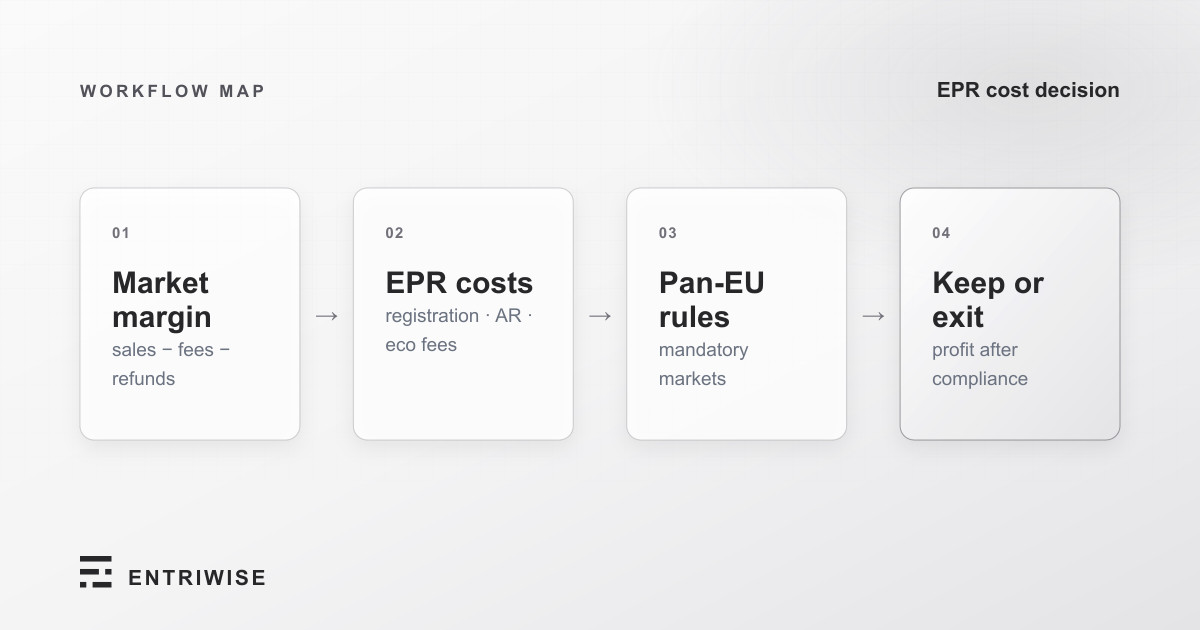
The decision this forces is not a compliance question. It’s an accounting one: which EU marketplaces earn more than they cost to stay legal in? Almost nobody can answer it, because the largest EPR cost — the Authorised Representative’s invoice — never appears in an Amazon settlement, so no report built from Amazon data can see it.
This guide covers what actually changed, why Pan-EU makes the arithmetic harder than it looks, where the EPR lines land in your books, and how to build the per-marketplace number that decides it.
What Changed on 12 August 2026
Extended Producer Responsibility is an old idea: whoever puts a packaged product on the market pays for collecting and recycling what’s left over. It runs in three separate streams, each with its own national registry, its own producer responsibility organisation (PRO), and its own registration number.
| Stream | What it covers | When the Authorised Representative duty began |
|---|---|---|
| Packaging | The box, the void fill, the poly bag, the printed insert | 12 August 2026, under PPWR Article 45 |
| WEEE | Anything electrical or electronic — a plug, a charger, an embedded circuit | In force for years under national WEEE law |
| Batteries | Loose cells, and batteries built into or shipped with a product | 18 August 2025, under Regulation (EU) 2023/1542 |
The packaging date is the one that just moved, and it moved in two ways at once. It created the Authorised Representative duty for non-EU producers, and it turned Amazon into an enforcer with a hard cutover rather than a gradual rollout.
Was there not supposed to be a reprieve? There was a proposal. In December 2025 the European Commission published an Omnibus simplification package that would have suspended the cross-border registration duty until 2035. Two problems: it was drafted for producers established in the Union selling cross-border into another member state — third-country producers were never covered — and in June 2026 the Council dropped the EPR provisions from its negotiating mandate. Plan on the obligation applying. If you are outside the EU, the proposal would not have helped you even if it had passed.
The UK is a separate bill, not a substitute for this one. UK packaging EPR has been running since 1 January 2025 on its own per-tonne fee schedule, and from the 2026-27 scheme year those fees are modulated by recyclability — hard-to-recycle formats pay a multiplier of the base rate. A UK seller shipping into the EU pays both regimes. See the UK government’s own guidance for the domestic side.
Why Being Outside the EU Costs More
A company established in Germany can walk up to a German PRO and register itself. A company established in the UK usually cannot. The member state requires a legal person inside its jurisdiction who can be served, audited, and fined — an Authorised Representative.
That is the whole mechanism, and it is why the invoices look the way they do. You are not buying a filing service. You are buying someone’s willingness to accept legal liability for your compliance in a country where you have no presence. Compliance agencies price that as an annual retainer, and it multiplies along two axes at once:
- Per country. A Spanish AR does nothing for you in Poland.
- Per stream. A packaging AR does nothing for you on WEEE or batteries.
A seller of a battery-powered consumer device, live in eight EU marketplaces, is looking at up to 24 separate relationships. The seller whose forum post prompted this article was quoted €2,000 for Spain alone.
Two things soften it, and both are worth chasing before you conclude a market is unviable:
- Multi-country package rates. Agencies that operate their own AR entities across several member states will price a bundle well below the sum of the parts. The gap between a top-tier legal firm and a specialist EPR provider on identical work is large.
- Going direct to the national PRO. In some countries the recycling organisation itself, or an AR it endorses, will take you on at a fraction of an intermediary’s markup.
Neither changes the shape of the problem: it is a fixed annual cost per country, unrelated to how much you sell there. That is exactly the cost structure that kills small markets.
The Pan-EU Trap
Pan-European FBA lets Amazon place your inventory across its European network and fulfil locally. Enrolment is what makes the cross-border fee economics work — and it is also what puts your product into countries you never chose.
Where Pan-EU can store inventory: Germany, France, Italy, Spain, Poland, Czechia and the Netherlands.
Where Pan-EU stores are available: Germany, France, Italy, Spain, the Netherlands, Poland, Sweden, Belgium and Ireland.
Where you must have live listings to stay enrolled: Germany, France, Italy, Spain — and, since June 2025, the Netherlands. The Netherlands became the fifth mandatory market, and sellers without an active Amazon.nl offer risk removal from the programme. See Amazon’s own Pan-European FBA page for the current programme terms.
Note that these are two different multipliers stacked on each other. Storage obliges you to be VAT-registered in each of the seven countries Amazon can place stock in. Sales oblige you to hold EPR registrations in every country you deliver to. Neither list is a subset of the other, and both are fixed annual costs.
That last line about mandatory markets is the trap, and it is the part the “just switch it off” advice misses. The mandatory list is not a menu. If the Netherlands is one of your loss-making markets, you cannot drop the Netherlands and keep Pan-EU — dropping it drops you out of the programme, which re-prices fulfilment in the four markets that were paying for everything.
The correction most sellers get wrong: EFN does not avoid EPR
The common advice is to leave Pan-EU, hold stock in one country, and serve the rest through the European Fulfilment Network. That is sound advice for some obligations and wrong for this one.
Packaging EPR is triggered by the sale — by first making the packaged goods available to an end user in that country — not by where the pallet sat. Ship a parcel from a German warehouse to a customer in Belgium and you have placed packaging on the Belgian market. EFN changes the fulfilment fee and the VAT and storage picture. It does not end the Belgian obligation.
What EFN genuinely buys you is control: you decide which countries you sell into, instead of Amazon deciding where your inventory goes. The only thing that ends an EPR obligation in a country is not selling there — and even then you still owe the reporting and contributions for the period you did.
One more wrinkle worth checking against your own Seller Central notices rather than taking from any guide, including this one: the statutory trigger is the sale, but Amazon’s verification has been reported as keying off inventory held in-country as well. The practical requirement can therefore be broader than the strict legal one, which matters most for Poland and Czechia — storage countries where you may have no deliberate sales strategy at all.
Pay on Behalf: What It Still Does, and What It Stopped Doing
Amazon’s EPR Pay on Behalf service collects the eco-contribution from your disbursements and pays the PRO for you. On 1 January 2026 its pricing got simpler and cheaper: the 3% variable service fee that applied in Spain and France was removed, replaced by a flat annual charge per EPR category.
| Store | Pay on Behalf service fee, per EPR category, per year |
|---|---|
| United Kingdom | £20 |
| Belgium, France, Italy, Spain | €25 |
Two EPR categories in France is €50 a year. Against a €1,400 AR retainer, that is not a close comparison — which is exactly why Pay on Behalf looked like the answer, and why its change in status matters so much.
What changed: Pay on Behalf continues as a payment mechanism. Under PPWR it is no longer a compliance mechanism, because the regulation requires the marketplace to verify that the seller holds a registration. Amazon paying your eco-contribution does not give you a registration number.
And note which countries are on that fee schedule. The UK, Belgium, France, Italy and Spain. Germany, the Netherlands, Poland, Sweden and Ireland are not — and the Netherlands and Poland are precisely where Pan-EU puts your inventory whether or not you have a plan for those markets. Details, including how the fees interact with account-level reserves and refunds, are in Amazon’s fee documentation.
The Decision Is Arithmetic. Most Sellers Can’t Do It.
Here is the question, stated properly:
For each EU marketplace, does its annual contribution margin exceed the annual fixed cost of being legally allowed to sell there?
Contribution margin means marketplace revenue minus everything variable: referral fees, FBA fulfilment, storage, returns and refunds, advertising, and the eco-contributions themselves. Not gross sales. Not a blended company-wide margin percentage applied to a marketplace’s revenue.
An illustrative eight-market seller — these numbers are invented to show the shape, not offered as benchmarks:
| Store | Gross sales / yr | Contribution @ 12% | Annual EPR cost | Net |
|---|---|---|---|---|
| amazon.de | €180,000 | €21,600 | €1,400 | +€20,200 |
| amazon.fr | €95,000 | €11,400 | €1,400 | +€10,000 |
| amazon.it | €48,000 | €5,760 | €1,300 | +€4,460 |
| amazon.es | €41,000 | €4,920 | €1,900 | +€3,020 |
| amazon.nl | €9,400 | €1,128 | €1,500 | −€372 |
| amazon.pl | €6,800 | €816 | €1,100 | −€284 |
| amazon.be | €4,100 | €492 | €1,200 | −€708 |
| amazon.se | €3,200 | €384 | €1,000 | −€616 |
Four markets carry the business. Four destroy value, and together they lose about €2,000 a year — small enough to hide inside a healthy consolidated P&L forever, and large enough to be the difference between a good year and a flat one for a seller this size.
Read the table again with the Pan-EU rule applied, though. The Netherlands is mandatory. It cannot be dropped in isolation. So the real choice is not “cut four markets” — it is a package decision:
Why the number is usually wrong
The largest EPR cost is the AR retainer, and the AR retainer is not an Amazon charge. It arrives as an invoice from a compliance agency, paid by bank transfer, entirely outside Seller Central.
That has a specific and expensive consequence: every analytics tool that reads Amazon data — Seller Central’s own reports included — is structurally incapable of seeing the cost that decides the question. A per-marketplace P&L built from Amazon data alone will show the Netherlands and Belgium as modestly profitable, because the €2,700 that makes them unprofitable is sitting in a different system.
The fix is unglamorous, and it is the whole job: code the compliance invoices to the same dimension you use for the marketplace. If you segment Amazon activity by class, location, or customer per marketplace, the AR invoice for Spain gets the Spain dimension too. Then a single P&L-by-class report answers the question in one line each, and it stays answered next quarter.
We have written up the mechanics of that segmentation separately — clearing accounts per marketplace, class versus customer-level reporting, and multi-currency handling — in Track Amazon Sales by Marketplace in QuickBooks Online. The EPR case is the same machinery with one extra habit: tag the non-Amazon costs too.
Where EPR Actually Lands in Your Books
Eco-contributions that Amazon pays on your behalf come back to you as deductions inside the settlement, under their own named fee lines. These are the real strings, as they appear in the settlement flat file — country and category are baked into the name:
| Settlement fee name | What it is |
|---|---|
Eco-Contribution for EPR Pay on Behalf - FR - Packaging and Printed Paper (PPP) |
France’s packaging and printed-paper eco-contribution, recovered from you |
Eco-Contribution for EPR Pay on Behalf - FR - Electrical and Electronic Equipment (EEE) |
The French WEEE-stream contribution |
Eco-Contribution for EPR Pay on Behalf - FR - Textile |
The French textile-stream contribution |
Eco-Contribution for EPR Pay on Behalf - ES - Packaging |
Spain’s packaging eco-contribution |
Eco-Contribution for EPR Pay on Behalf - GB - Packaging |
The UK packaging eco-contribution |
Amazon Service Fee for EPR Pay on Behalf - <country> - <category> |
Amazon’s charge for administering the above — the line that went flat-rate in January 2026 |
…plus a Tax variant of most of the above |
VAT charged on the contribution or on the service fee |
Two more get confused with EPR and are not it: RegulatoryFee and MarketplaceFacilitatorRegulatoryFee-Principal are government-mandated charges Amazon collects on certain product categories — battery and electronics recycling levies, typically — under a different mechanism. Booking them into your EPR account will quietly corrupt the comparison you are trying to make. Every one of these names, with the rest of Amazon’s fee vocabulary, is in our Amazon Seller Fees Glossary.
Three rules for the chart of accounts:
- Give eco-contributions their own expense account, separate from “Amazon fees.” If they are merged into a fee bucket you cannot isolate the compliance cost, and the whole exercise fails at step one.
- Split it by country using a dimension, not by account. Ten accounts named “EPR — Spain” is a chart of accounts nobody will maintain. One account, dimensioned by marketplace, reports the same thing and survives adding a market.
- Put the AR retainer and the PRO fees in that same account, with the same dimension. They are the same economic cost as the eco-contribution. Only the payment route differs.
Do those three and the keep-or-drop decision becomes a report you already run, rather than a spreadsheet exercise you do once, believe for a quarter, and never repeat.
Four Options, Priced
| Option | What it does to EPR | What it does to fulfilment | Accounting consequence |
|---|---|---|---|
| Stay full Pan-EU | Obligation in every store you list in, plus every country holding stock | Lowest per-unit fees, local delivery promise everywhere | Compliance is a fixed cost of the programme; measure it against total Pan-EU contribution, not per market |
| Leave Pan-EU, run EFN from one hub | Unchanged for any country you still sell into. Ends the mandatory-market obligation only | Higher per-unit fees, slower delivery, one storage footprint | Fulfilment cost per unit rises across the board — model this before assuming it is cheaper overall |
| Multi-Country Inventory in chosen countries | Obligation in the countries you deliberately pick | Local fees where you chose to place stock | The middle option, and the one where per-marketplace contribution data pays for itself |
| Delist a country entirely | Ends the obligation going forward; reporting for the period you sold still stands | No change elsewhere | Watch for stranded costs — an annual retainer already paid is not recovered by delisting in month three |
The honest summary: for a seller whose small markets are genuinely marginal, selective Multi-Country Inventory from a hub beats both extremes, and the only reason it is not the obvious answer is that most sellers do not have the per-marketplace numbers to identify which markets are marginal.
How to Actually Use This
The compliance side of this — choosing an AR, getting the registration numbers, filing the declarations — is a job for a specialist EPR provider, and the difference between a good one and an expensive one is thousands a year. Get more than one quote, and ask specifically about multi-country package pricing.
The part that is yours to own is the number that tells you which countries are worth paying for at all:
- Track Amazon Sales by Marketplace in QuickBooks Online — clearing accounts per marketplace, class versus customer-level P&L, multi-currency.
- How to Reconcile Amazon Settlements in QuickBooks Online — where deductions like these sit inside a settlement, and how to make the deposit match.
- Amazon Seller Fees Glossary — every fee name above, plus the 120-odd others.
Entriwise posts your Amazon activity — sales, refunds, fees, advertising, and the eco-contribution lines named on this page — into QuickBooks or NetSuite as native transactions, marketplace by marketplace, with the payout reconciling to the penny. That gives you contribution margin per store as a report you already have, instead of a project. Add the AR and PRO invoices against the same dimension and the keep-or-drop decision is one line per country.
See the Amazon Seller Central QuickBooks Online integration for how it works, or Amazon profitability analytics for the per-SKU layer underneath it. The free trial covers one full calendar month of your own data, with no credit card — enough to produce the per-marketplace numbers before you commit to a decision about Pan-EU.
Frequently Asked Questions
Do I still need my own EPR registration if Amazon pays my eco-contributions?
Yes. Since PPWR took effect on 12 August 2026, marketplaces must verify that the seller holds a valid EPR registration in each EU country where the goods are made available. Amazon’s Pay on Behalf service continues to collect and remit the eco-contribution for you, but it is a payment mechanism, not a registration. Relying on it alone leaves you without the number Amazon is now obliged to check, which is what triggers listing deactivation country by country.
Why do I need an Authorised Representative when a German company doesn’t?
Because the member state needs a legal person inside its own jurisdiction that it can hold responsible. A producer established in that country can register directly with the national scheme. A producer established outside the EU cannot, so the law requires you to appoint an EU-established Authorised Representative who accepts that liability on your behalf. The retainer is priced for the liability, not for the paperwork, which is why it runs to hundreds or thousands per country per year.
Does switching from Pan-EU to EFN get me out of EPR?
No. Packaging EPR is triggered by placing packaged goods on the market in a country — the sale and delivery to an end user there — not by where the inventory was stored. Shipping to a Belgian customer from a German warehouse still creates a Belgian obligation. What EFN does buy you is control over which countries you sell into at all, plus a simpler VAT and storage footprint. The only way to end an obligation is to stop selling into that country, and you still owe reporting for the period you did.
Can I just turn off the small marketplaces?
Sometimes. Poland, Belgium, Sweden and Ireland can be delisted individually. Germany, France, Italy, Spain and the Netherlands cannot if you want to stay in Pan-European FBA — the Netherlands became the fifth mandatory market in June 2025, and dropping it risks removal from the programme entirely. So the decision on a loss-making mandatory market is really a decision about whether Pan-EU as a whole still pays.
How much does EPR compliance actually cost per country?
There is no published rate card, because it depends on the country, the stream, your volumes, and the provider. Sellers currently report Authorised Representative retainers in the €500 to €2,000-plus range per category per country per year, with quotes at the top of that range for Spain. On top of the retainer sit the eco-contributions themselves, which scale with your packaging weight and product volumes, and Amazon’s Pay on Behalf service fee where it applies — £20 in the UK, €25 in Belgium, France, Italy and Spain, per EPR category per year since January 2026.
Where do EPR fees show up in my Amazon settlement?
As named deductions with the country and category in the name — for example Eco-Contribution for EPR Pay on Behalf - FR - Packaging and Printed Paper (PPP), or Eco-Contribution for EPR Pay on Behalf - GB - Packaging, usually alongside a matching Tax line and an Amazon Service Fee for EPR Pay on Behalf line for administering it. Note that RegulatoryFee and MarketplaceFacilitatorRegulatoryFee-Principal are separate charges — battery and electronics recycling levies collected under a different mechanism — and should not be posted to your EPR account.
Why doesn’t my profitability tool show the EPR cost?
Because the largest part of it never touches Amazon. Eco-contributions come through the settlement and are visible, but the Authorised Representative retainer and any direct PRO fees arrive as invoices from a compliance agency and are paid by bank transfer. Any report built only from Amazon data is structurally blind to them, which makes small marketplaces look profitable when they are not. Fixing it means coding those invoices to the same class, location, or customer dimension you use to segment the marketplace, so both halves of the cost land in the same P&L column.
Is UK packaging EPR the same obligation as the EU one?
No, they are separate regimes and a UK seller shipping into the EU pays both. UK packaging EPR has applied since 1 January 2025 on its own per-tonne fee schedule, with fees modulated by recyclability from the 2026-27 scheme year so that hard-to-recycle formats pay a multiple of the base rate. Registering in the UK gives you nothing in the EU, and an EU registration gives you nothing in the UK.